
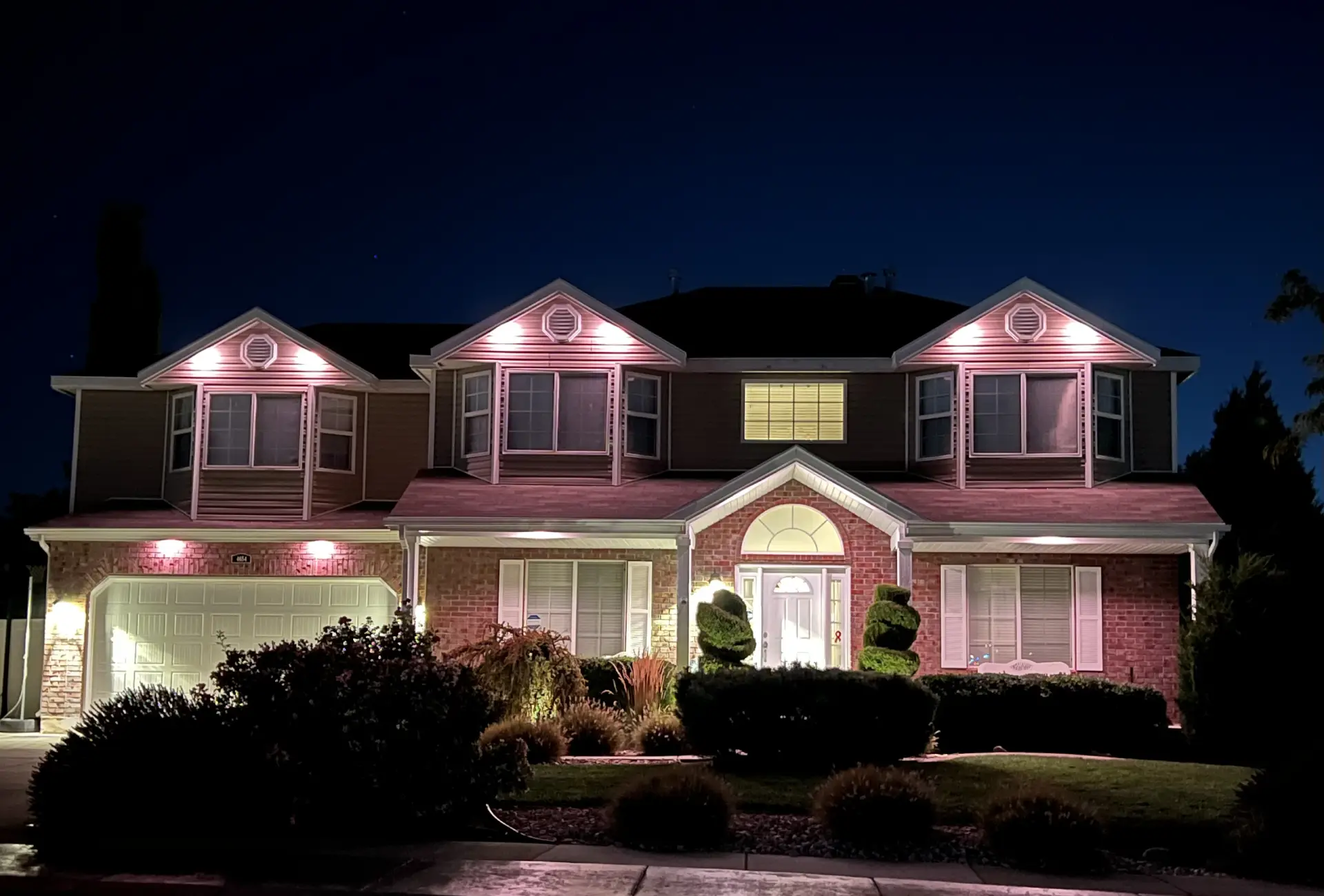
Most homeowners think about outdoor lighting in terms of visibility. Can you see the front door? Is the driveway safe to navigate at night? Those things matter, but they’re only part of the story.
The homes that genuinely stand out after dark aren’t just lit. They’re designed. And one of the most effective, most underused tools in outdoor lighting design is down lighting.
We’ve worked with hundreds of homeowners across the Denver metro, and we see the same reaction every time: people walk up to a home with well-placed down lighting and they feel something before they can explain why. It looks expensive. It looks intentional. And honestly, it looks like the house belongs there.
Here’s what’s actually happening, and how you can get that same result.
What Down Lighting Actually Does
Down lighting places fixtures high on a structure, typically under eaves, soffits, overhangs, or pergolas, and directs light downward toward the surface below. That sounds simple. The effect it creates is anything but.
When light falls from above at the right angle, it grazes across textured surfaces like stone, brick, and stucco in a way that brings out depth and dimension that you’d never notice in flat light. Shadow and highlight work together. A stone facade that looks flat during the day suddenly has character at night. An entry with architectural detail becomes a proper focal point rather than just a door.
There’s also a practical dimension. Down lighting illuminates steps, walkways, and seating areas without creating glare. Guests can see where they’re going. The space feels safe and welcoming without feeling like a parking lot.
Think of it as the difference between a floodlight and a spotlight held at the right angle by someone who knew what they were doing.
Where Down Lighting Works Best
Rooflines and eaves are the most natural starting point. Mounting fixtures under overhangs lets light wash gently across the main facade of the house. Done right, it mimics the quality of moonlight filtering down from above. Soft. Even. Completely natural-looking.
Patios and covered porches benefit enormously from down lighting placed in soffits or overhead structures. Instead of a single bright fixture blasting light in one direction, you get layered illumination that covers the whole space evenly. Dinner outside feels different when the light is coming from the right place.
Entryways and architectural details deserve special attention. If your home has interesting trim work, columns, arched windows, or a stone veneer entry, down lighting is how you show those off. It’s the difference between a home that looks like every other house on the block at night and one that actually has presence.
Pergolas and arbors create an opportunity to place fixtures up in the structure and cast those organic shadow patterns down onto decking or patio surfaces. It adds an almost artistic quality to the space that’s hard to replicate any other way.
Getting the Design Right
A few principles separate down lighting that looks great from down lighting that just exists.
Keep the fixture out of view. The goal is to see the effect, not the hardware. Low-profile fixtures mounted discreetly under soffits or inside structural channels let the light do its work without drawing attention to themselves. When someone looks at your home and thinks “that looks beautiful,” they shouldn’t be thinking about where the light is coming from.
Color temperature shapes the entire feel of the space. We consistently recommend warm white tones in the 2700K to 3000K range for residential down lighting. That range creates an inviting, comfortable atmosphere. Push cooler than that and the light starts to feel clinical. Push warmer and you lose definition. Warm white hits the right balance for almost every home exterior.
Consistency across the facade matters. Spacing and angle should be deliberate. Uneven spacing or fixtures pointed in slightly different directions creates a disjointed look that undermines the whole effect. This is one of the main reasons professional installation makes such a noticeable difference in the final result.
The Trimlight Approach to Down Lighting
At Trimlight Denver, our down lighting system was designed specifically to address the problems we kept seeing with other approaches. Running wires through soffits, cutting holes in exteriors, and bringing in an electrician for every installation adds cost and disruption that most homeowners don’t want. Our surface-mounted system attaches cleanly to the exterior without any of that. It looks identical to recessed can lighting once it’s in place.
The fixtures are built with RGB LED technology, which gives you more than just a warm white option. Through the Trimlight Edge app, you can adjust color, brightness, and patterns, or set a schedule that changes with the seasons. It integrates with Alexa and Google Home if you prefer voice control. And since it’s the same app you’d use for any other Trimlight product, everything works together from one place.
The low-profile design means the covers can even be painted to match your trim if you want them to disappear entirely during the day. We’ve seen homeowners who showed their house to visitors a week after installation and their guests hadn’t even noticed anything was different. They just noticed the house looked better.
Frequently Asked Questions
Q: What is the difference between down lighting and soffit lighting?
Soffit lighting is a specific type of down lighting where fixtures are recessed into or mounted beneath the soffit, the enclosed area under a roof overhang. Down lighting is the broader category. All soffit lighting is down lighting, but down lighting can also be mounted under pergolas, in eaves, or within other overhead structures.
Q: Does down lighting really make a visible difference on a home’s exterior?
In our experience, yes, and often more than homeowners expect. The effect of light grazing across architectural texture, framing an entryway, or washing evenly across a facade adds a quality to a home’s appearance that’s difficult to achieve with standard exterior fixtures. It’s one of those upgrades where the before and after speaks for itself.
Q: What color temperature should I choose for outdoor down lighting?
Warm white in the 2700K to 3000K range works best for most residential applications. It creates a welcoming, natural-feeling atmosphere without the harsh or clinical feel of cooler light temperatures.
Q: Is professional installation necessary for down lighting?
For a result that looks intentional rather than improvised, professional installation makes a meaningful difference. Fixture placement, spacing, and angle all affect the final appearance. Trimlight’s factory-trained technicians handle the full process, from layout design through installation and app setup.
Q: Can Trimlight down lighting be used alongside other lighting systems?
Yes. Trimlight’s down lighting system is designed to integrate with the broader Trimlight ecosystem, including permanent accent lighting along rooflines and patio lighting. Everything is controlled through the same app, so managing multiple lighting zones across your home’s exterior is straightforward.
Q: How does Trimlight’s down lighting system handle Colorado’s climate?
Trimlight’s fixtures are built with durable, energy-efficient LED components and weatherproof materials designed for year-round outdoor use. Colorado’s mix of summer heat, UV intensity, hail, and winter freeze cycles demands more from outdoor lighting than most climates, and the system is engineered with that in mind.
See What Down Lighting Can Do for Your Home
There’s a version of your home’s exterior that you probably haven’t seen yet. Down lighting is one of the most effective ways to reveal it.
If you’re in the Denver, Aurora, Parker, Highlands Ranch, or Castle Rock area and you’re curious what a professionally designed down lighting installation would look like on your home, we’d love to show you.
Contact Trimlight Denver today for a free quote. Our team will walk you through the options, design a layout that fits your home’s architecture, and handle every detail of the installation. No ladders, no tangled wires, no repeat visits every season. Just lighting that works beautifully from day one.