
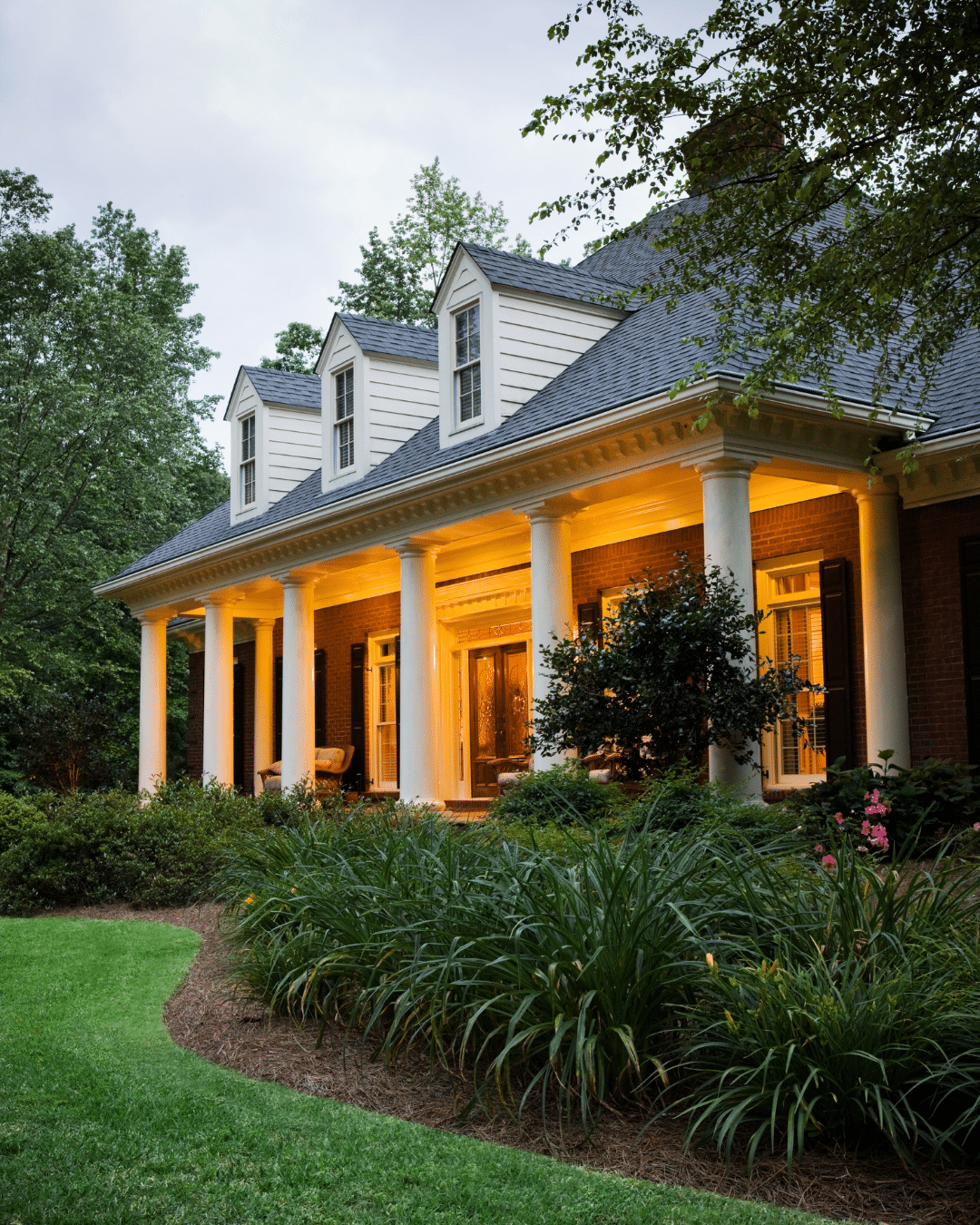
This question comes up more than you might expect. A homeowner calls us interested in down lighting for their home’s exterior, and somewhere in the conversation they ask: “Is that the same thing as recessed lighting?” It’s a fair question. The two terms get used interchangeably all the time, and honestly, the overlap between them creates genuine confusion.
So let’s sort it out. Because understanding the distinction actually matters, especially when you’re making decisions about your home’s architecture and how it looks after dark.
The Short Answer
All recessed lights are down lights. Not all down lights are recessed.
That’s the core of it. But the longer answer is where things get interesting, particularly for homeowners thinking about exterior lighting design.
What Recessed Lighting Actually Means
A recessed light is a fixture installed inside a ceiling cavity so the housing sits completely hidden behind the surface. What you see from below is just a trim ring, flush with the ceiling. No visible fixture. No hardware sticking out. Just a clean circle of light appearing from what looks like nothing.
These are also called can lights or pot lights, names that describe the cylindrical housing unit buried in the ceiling. The bulb sits deep inside that cavity, which naturally controls glare. Because the light source is physically set back from the surface, you’re less likely to see the bulb directly when you glance up.
Recessed lighting works beautifully in spaces where a clean, uncluttered ceiling line matters. Open-plan living rooms, kitchens, hallways. The fixtures essentially disappear into the architecture.
The trade-off is installation. To put recessed lights in a ceiling, you need adequate depth in the cavity above, usually several inches at minimum. You’re cutting into the surface. Wires need to be routed through the structure. For new construction or a renovation where walls are already open, that’s manageable. For an existing finished ceiling, or for outdoor applications where there’s no cavity to work with at all, it gets complicated quickly.
What Down Lighting Means in a Broader Sense
Down lighting simply describes the direction light travels: downward. Any fixture that points light toward the floor or ground is technically a down light. That includes recessed lights, yes, but it also includes surface-mounted fixtures that attach directly to a ceiling, soffit, or overhang without any cavity required.
Surface-mounted down lights are visible as small discs or cylinders on the ceiling. The hardware isn’t hidden. But modern low-profile designs sit so close to the surface that they read as intentional architectural detail rather than obvious fixtures. You notice the effect far more than the hardware, which is really the goal.
For exterior applications, this distinction becomes critical. Most outdoor overhangs, soffits, and pergola structures don’t have the cavity depth needed for true recessed installation. Surface-mounted down lighting solves that problem entirely. The fixture attaches to the exterior surface, requires no interior access, and delivers the same downward illumination effect without the invasive installation process.
How This Plays Out in Exterior Lighting Design
This is where our work at Trimlight comes in directly. When homeowners ask us about exterior down lighting, what they’re usually picturing is that recessed can light look, where the light seems to emerge cleanly from the architecture without any visible hardware. That’s a completely achievable result. The path to get there, though, looks different for outdoor applications.
Our down lighting system is surface-mounted, which means installation doesn’t require cutting into your exterior or running wires through your soffit. The fixtures attach cleanly to the surface and sit low enough that they read as part of the home rather than an add-on. Several of our customers have had the covers painted to match their trim so the fixtures become nearly invisible during daylight hours. At night, what you see is the effect: light washing down across the facade, highlighting texture, framing architectural features, improving visibility at entries and walkways.
The fixtures connect to the Trimlight system and are controlled through the Trimlight Edge app. That means color, brightness, and scheduling are all adjustable from a phone. It integrates with Alexa and Google Home as well. The practical result is outdoor down lighting that looks like recessed lighting and behaves like a smart home system.
Which One Is Right for Your Situation?
For interior applications with adequate ceiling depth, traditional recessed lighting is a proven, polished solution. It hides hardware completely and produces a very clean architectural look.
For exterior applications, or any situation where cutting into a ceiling or soffit isn’t practical, surface-mounted down lighting delivers comparable results with a fraction of the installation complexity. The light still travels downward. The effect on your architecture is still dramatic. The process of getting there is much simpler.
The real question isn’t which one is technically superior. It’s which one fits the actual structure you’re working with. Most of the time, for exterior residential lighting in the Denver metro area, the answer is surface-mounted down lighting installed properly by someone who knows how to make it look like it was always part of the building.
Frequently Asked Questions (FAQs)
They overlap significantly but aren’t identical. Recessed lighting refers specifically to fixtures installed flush inside a ceiling cavity. Down lighting is the broader category, describing any fixture that directs light downward, including both recessed and surface-mounted options. Most recessed lights are down lights, but not all down lights are recessed.
True recessed lighting requires a cavity behind the ceiling surface, adequate structural depth, and weatherproofing appropriate for outdoor conditions. In most exterior applications, such as soffits, eaves, and pergola structures, that cavity doesn’t exist. Surface-mounted down lighting is the practical alternative that achieves a similar visual result without the structural requirements.
Up close, yes. Surface-mounted fixtures are visible as small discs or cylinders. At a normal viewing distance, well-designed low-profile fixtures read as part of the architecture rather than obvious hardware. Many homeowners paint the covers to match their trim, which reduces visibility further. The light effect produced is very similar to recessed lighting.
Trimlight’s exterior down lighting is surface-mounted, meaning no ceiling cutting or cavity access is required. Fixtures attach directly to the exterior surface and connect to the Trimlight system for full app-based control of color, brightness, and scheduling. The result looks nearly identical to recessed can lighting once installed, but the process is far less invasive.
It’s one of the most effective techniques available for that purpose. Light directed downward from eaves, soffits, or overhangs grazes across textured surfaces like stone, brick, and stucco, creating depth and shadow that flat lighting completely misses. Entryways, rooflines, and architectural details come to life in a way that standard wall fixtures simply can’t replicate.
With LED-based systems like Trimlight’s, maintenance needs are minimal. LED bulbs last significantly longer than traditional incandescent options and are built to handle outdoor conditions. When a bulb does eventually need replacing, Trimlight’s system is designed for straightforward access without requiring removal of exterior components or professional intervention for basic upkeep.
Ready to See the Difference on Your Own Home?
Understanding the distinction between down lighting and recessed lighting is one thing. Seeing what the right outdoor down lighting installation actually does to a home’s exterior is another conversation entirely.
We work with homeowners across Denver, Aurora, Highlands Ranch, Parker, and Castle Rock, and the before-and-after on a well-designed down lighting installation is one of the more satisfying parts of what we do.
Contact Trimlight Denver today for a free quote. We’ll take a look at your home’s architecture, talk through what’s possible, and design an installation that makes your exterior look the way it was always meant to look after dark.